International Desk:
Dhaka, Aug-18,
After struggling for months to persuade
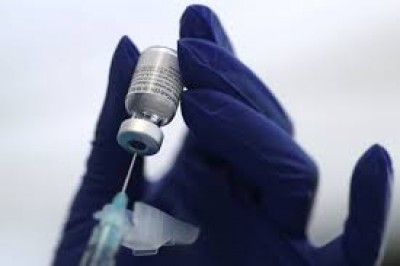
Americans to get the COVID-19 vaccine, U.S. health officials could soon face a
fresh challenge: talking vaccinated people into getting booster shots to gain
longer-lasting protection as the delta variant sends infections soaring again.
As early as this week,
U.S. health authorities are expected to recommend an extra dose of the vaccine
for all Americans eight months after they get their second shot, according to
two people who spoke to The Associated Press on condition of anonymity to
discuss internal deliberations.
That means the biggest
vaccination drive in U.S. history is about to get even more extensive.
The move is being
driven by both the highly contagious variant and preliminary evidence that the
vaccine’s protective effect starts dropping within months.
The new urgency from
U.S. officials reflects how quickly the variant has knocked the country back on
its heels. On July Fourth, President Joe Biden proclaimed that the nation was
declaring its independence from the virus. But since then, infections,
hospitalizations and deaths have increased nationwide, overloading emergency
rooms across parts of the South and West.
When Pfizer announced
plans in July to apply for approval for boosters, U.S. officials shot back that
it was too early to know whether they were needed. Experts worried that a new
campaign calling for boosters would muddle the continuing campaign to win over
the tens of millions of Americans who are skeptical or hesitant to get their
first shots.
“We have to really make
sure that while we’re spending a lot of time and effort on third doses that we
don’t undermine our campaign for first vaccinations,” Lawrence Gostin, a public
health specialist at Georgetown University, said Tuesday. “That’s truly the existential
crisis in the United States.”
Calling for third doses
could discourage people who had been skeptical of the shot’s effectiveness in
the first place, Gostin warned.
Booster shots would
only begin to be administered widely once the Food and Drug Administration
formally approves the vaccines, which are being dispensed for now under what is
known as emergency use authorization. Full approval of the Pfizer shot is
expected in the coming weeks.
Last week, U.S. health
officials recommended boosters for some people with weakened immune systems,
such as cancer patients and organ transplant recipients.
The director of the
National Institutes of Health, Dr. Francis Collins, said Sunday the U.S. could
decide in the next couple of weeks whether to offer booster shots this fall to
other Americans as well.
Among the first to
receive them could be health care workers, nursing home residents and other
older Americans, who were some of the first to be vaccinated once the shots
were authorized last December.
More than 198 million
Americans have received at least one dose of a COVID-19 vaccine, or 70% of
those who are eligible, according to the Centers for Disease Control and
Prevention. Just under 60% of Americans 12 and older are fully vaccinated.
The vaccination drive
has been slower than the Biden administration had hoped for. At the same time,
the variant is spreading aggressively through unvaccinated communities and also
causing an increasing number of “breakthrough infections” of fully inoculated
people.
Studies show the
vaccine remains highly protective against severe COVID-19, but results from
Israel released last month suggest its effect wanes. Its effectiveness against
symptomatic infection peaked at 96% two months after study participants got
their second dose. Four months later, it was down to 90%. By six months, it was
about 84%.
Israel, which
exclusively administered the Pfizer shot, has been offering a booster to people
over 50 to control its delta surge. Researchers are still trying to understand
to what extent the breakthrough infections are due to waning immunity or
vulnerability to the delta variant.
On Tuesday, European
medical regulators said they are talking with vaccine developers about the need
for boosters but haven’t made any decisions.
On Monday, Pfizer and
its partner BioNTech announced they submitted data to the FDA to support
authorizing a booster shot for the general public. Pfizer said a small study
showed people who received a third dose had higher levels of antibodies against
several versions of the coronavirus, including the delta variant. The company
is working on a larger study.
Americans who received
the earliest doses of Pfizer’s vaccine — mainly health care workers and nursing
home residents — are approaching the eight-month mark from when they received
their second dose.
“There is a concern
that the vaccine may start to wane in its effectiveness,” the NIH’s Collins
said. “And delta is a nasty one for us to try to deal with. The combination of
those two means we may need boosters, maybe beginning first with health care
providers, as well as people in nursing homes, and then gradually moving
forward” with others.
He said because the
variant only started hitting the country hard in July, the next couple of weeks
of case data will help the U.S. make a decision.
The Pfizer and Moderna
vaccines are administered in two doses. Officials are continuing to collect
information as well about the one-shot Johnson & Johnson vaccine, which was
only approved in the U.S. in late February, to determine when to recommend
boosters.
The White House has
said that even though the U.S. has begun sharing more than 110 million vaccine
doses with the rest of the world, the nation has enough to deliver boosters to
Americans.
Global health
officials, including the World Health Organization, have called on wealthier
and more-vaccinated countries to hold off on booster shots to ensure the supply
of first doses for people in poor corners of the world.
Gostin said the Biden
administration’s plans to recommend boosters for all Americans are “a slap in
the face” to other nations that haven’t yet been able to vaccinate their most
vulnerable people.
“It’s tone-deaf to the
rest of the world that can’t even get any doses,” he said.
End/Dct/Int/Sma/